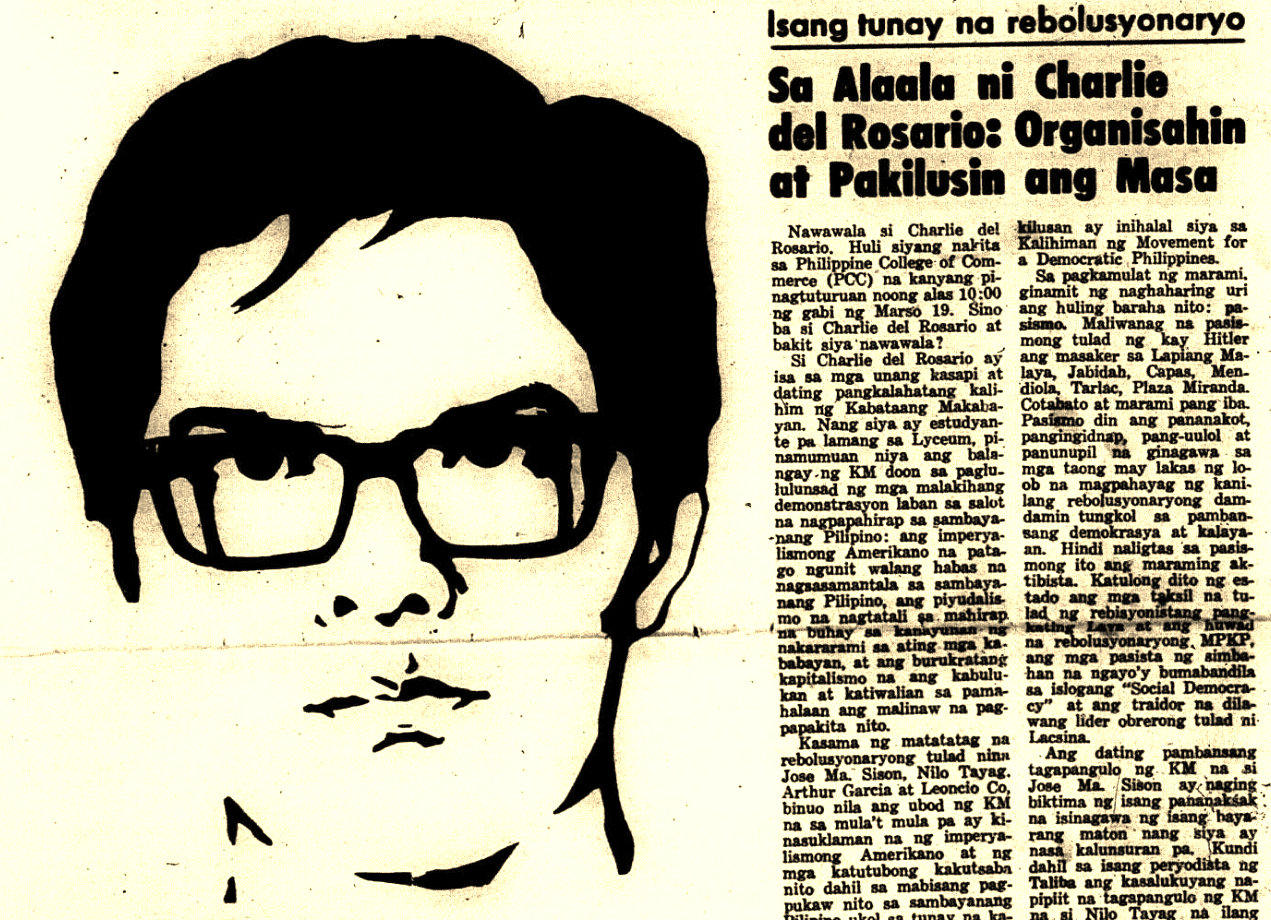
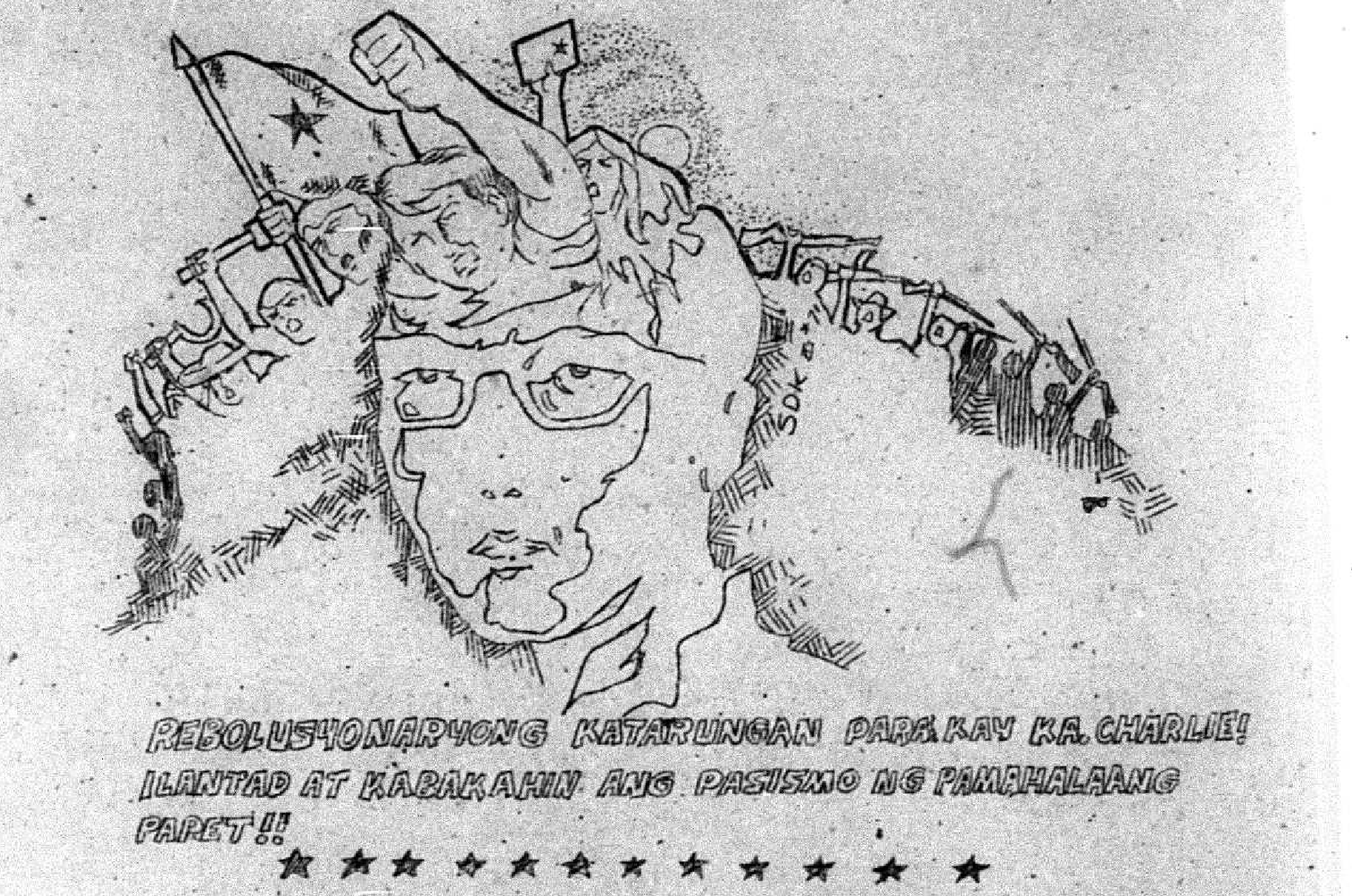
“Sa alaala ni Charlie del Rosario (In memory of Charlie del Rosario).” April-May 1971 cover of Kalayaan, publication of Kabataang Makabayan (KM). Shortly after ten on Friday night, 19 March 1971, Carlos del Rosario, known to friends as Charlie, a leader of the Kabataang Makabayan (KM) and Political Science instructor at the Philippine College of Commerce (PCC), disappeared and was never seen again. His fellow activists blamed the Marcos government for the disappearance; his family petitioned the President for information about Charlie’s whereabouts. The Marcos government denied any knowledge of what had happened to Charlie del Rosario.
Del Rosario’s disappearance foreshadowed the crimes of martial law. His name is carved in the black granite wall of the Bantayog ng mga Bayani. The Student Center of the Polytechnic University of the Philippines (PUP), to which PCC was renamed in 1978, is the Charlie del Rosario Building. But we did not know what actually happened to Charlie del Rosario, until now.
The discovery of a five-page document, hidden away among over half a million pages of material collected by the Presidential Commission on Good Government (PCGG), finally answers this question after fifty-one years of uncertainty. Charlie del Rosario was abducted, interrogated, tortured, forced to dig his own grave, and murdered by the forces of the Presidential Security Unit (PSU) under the direct control of Fabian Ver. A transcript of del Rosario’s interrogation, including details of his torture and murder, was typed up and given to the president within days of his disappearance.
Who Was Charlie del Rosario?
Charlie del Rosario was born in 1943, the eldest son of a modestly well-to-do family in Santa Cruz, Manila. His parents operated a dry-goods store on Blumentritt, and his father was vice president of the Vendors Association. Charlie was an honors student in elementary and high school. He studied Political Science at Lyceum and was elected vice president of the student council.
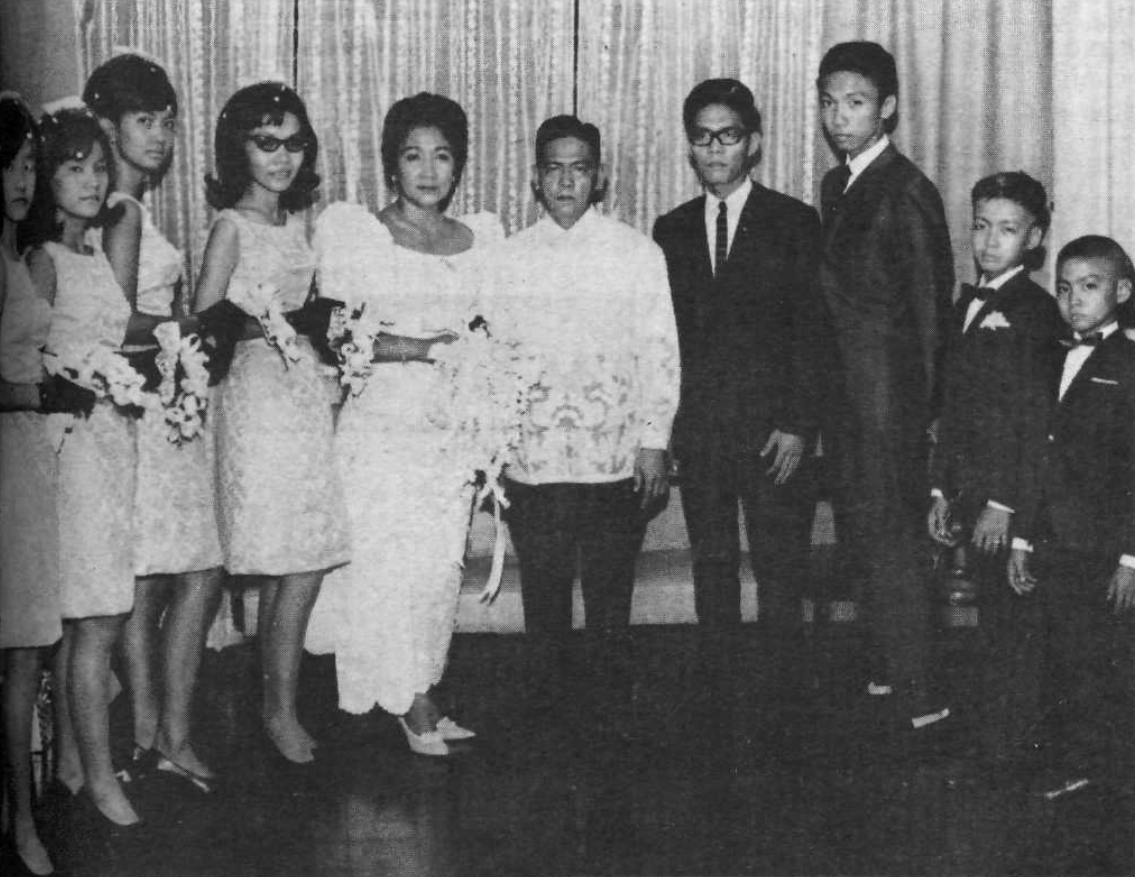
It was at Lyceum that del Rosario encountered the revolutionary politics that would become his life’s focus. In the middle of 1964, Paquito Lava, a faculty member and a leader in the Partido Komunista ng Pilipinas (PKP), recruited to the faculty Jose Ma. Sison who, along with Lava, was a member of the executive committee of the PKP. Del Rosario worked closely with Sison from this point forward.
In November 1964, Sison, del Rosario, and a group of others founded the Kabataang Makabayan (KM), a radical youth organization that was then secretly tied to the PKP. Sison was made national chair, del Rosario national treasurer. While Sison and other leaders of the KM occupied the public eye, del Rosario worked tirelessly in the background. The KM later wrote in an obituary that “Kaunti lang ang nakakilala kay Ka Charlie. Hindi siya gaanong kilala tulad ng ilang mga lider.” (Only a few knew Comrade Charlie. He was not as well known as some leaders.)
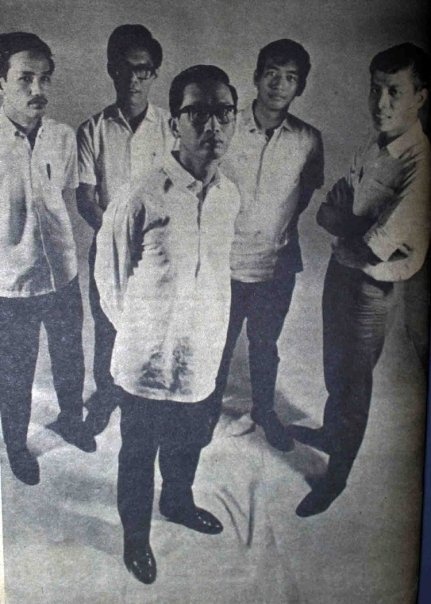
Sison and a handful of others were expelled from the PKP in 1967, when the tensions of the Sino-Soviet split tore apart Philippine Communism. Del Rosario became a member of the Central Comittee of the new Communist Party of the Philippines (CPP) after its founding in December 1968.
In 1969 del Rosario was hired as a faculty member of Political Science at PCC. Marcos was re-elected at the end of the year, and an immense wave of protests broke out in early 1970. In the midst of these struggles, del Rosario met Frances de Lima, sister of Sison’s wife Juliet de Lima, in the Sison’s home and they secretly married on 8 October 1970. They found a place and moved in together at the end of January 1971. Charlie would be dead within two months.
Abduction and Murder
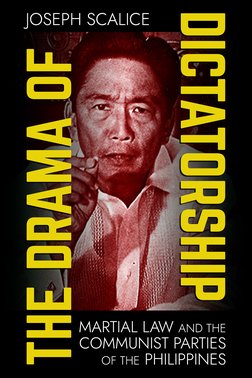
The Drama of Dictatorship is available from
* Cornell University Press
* Ateneo de Manila University Press
1971 was a year of immense political instability. I detail the upheaval in my book The Drama of Dictatorship: Martial Law and the Communist Parties of the Philippines (Cornell and Ateneo, 2023). Marcos’ plans to impose dictatorship were well advanced. The apparatus at the center of his preparations was the Presidential Security Unit. Shortly after taking office in 1966, Marcos, with substantial funding from Washington through USAID’s Office of Public Safety (OPS), set about transforming the ceremonial presidential guard into his personal network of intelligence and repression overseen by the doggedly loyal Ver, who rose from the rank of Captain to Brigadier General by 1971. OPS brought many of Ver’s top officers to the United States, where at Fort Bragg and elsewhere, they were trained in the art of torture.
Torture was instrumental in the creation of the Marcos dictatorship. The early intelligence collected on the CPP was remarkably poor. The military did not know the identity of many party leaders or even the rudimentary affiliations of some legal organizations. Spearheaded by the PSU, they sought to fill out the gaps in their knowledge by means of torture.
Del Rosario was on the executive board of a labor party, the Socialist Party of the Philippines (SPP). Founded in 1967, the SPP, headed by a union leader named Ignacio Lacsina, was awkwardly positioned between the warring factions of the PKP and the CPP. The PKP was increasingly allied with Marcos; some of its supporters were already working in his administration. In 1971 Lacsina sought to align with the PKP and with Marcos. He ousted all KM representatives from the SPP, but found he could not remove del Rosario from the executive board.
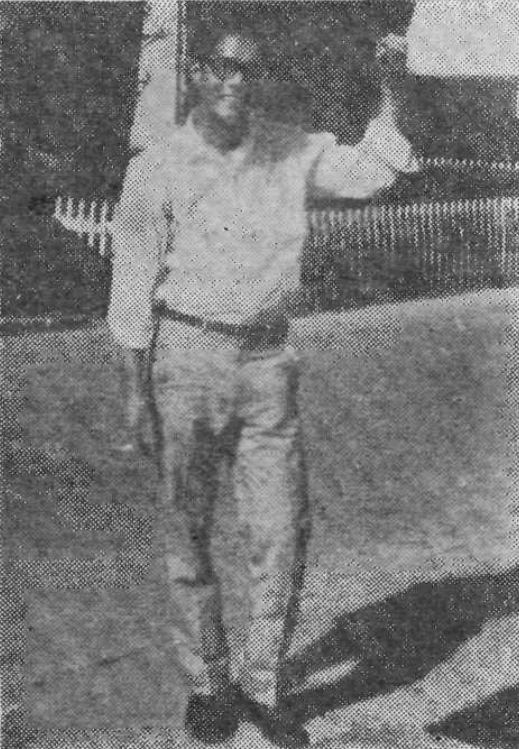
Lacsina held a press conference on 29 January and announced that del Rosario was “representing Jose Ma. Sison.” His ‘red-tagging’ served its purpose. A military intelligence report in the month of February prepared for the President noted Lacsina’s exact words (PCGG, Roll 2, Frame 1092). Del Rosario was the first aboveground leader of the CPP of which the Marcos government was aware. Plans were set in motion for his abduction.
On 19 March, del Rosario left the PCC campus, then still on Lepanto, and headed to Cubao. He never arrived.
The next week a five-page document, entitled “Intelligence Report on the New Communist Party of the Philippines,” was placed on the desk of Ferdinand Marcos (PCGG, Roll 2, Frames 1233-1237). The first page contained a rough outline of the organizational structure of the CPP. The second listed the names of members of the Politburo and Central Committee. The remaining three pages were the transcript of an interrogation.
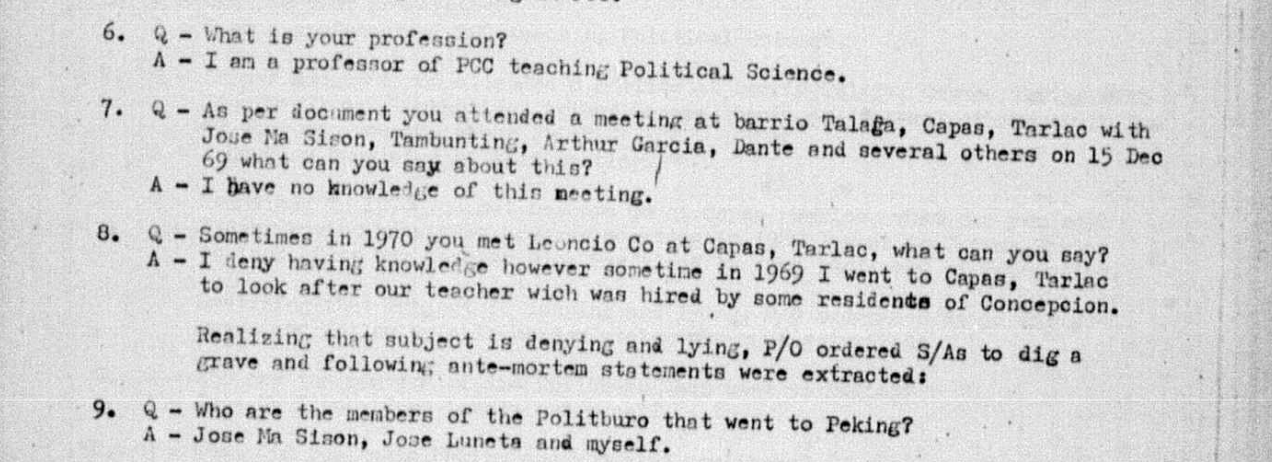
The subject of the interrogation stated that he was “a professor of PCC teaching Political Science.” This can only have been Charlie del Rosario. The interrogator asked about a meeting with Sison. The transcript reads “Realizing that subject is denying and lying, P/O ordered S/As to dig a grave and following ante-mortem statements were extracted.” Ante-mortem is chilling and crystal-clear: before death.
Twenty questions later, we read “Subject after receiving the first blow on his right face with a shovel changed attitude of answering questions.”

The torturers collected del Rosario’s pocketbook, and noted Francisco Sison, a member of Marcos’ Presidential Economic Staff and brother to Jose Ma., among those listed there. The transcript concluded, recommending Francisco Sison “be under surveillance PSU.” Two months later, on 24 May, Francisco Sison and his driver, Elpidio Morales, were abducted and never seen again.
Ferdinand Marcos was a pathologically dishonest man. He often lied in his own diary, intent on producing a manufactured legacy to be uncovered by future historians and biographers. On 25 March, with the transcript of del Rosario’s murder likely still on his desk, Marcos wrote in his diary, “The KM suspects (or says so publicly anyway) that the military apprehended [del Rosario] and did away with him. This is not true. He was probably liquidated by his rivals for leadership.”
The martial law regime that was imposed the next year unleashed the force of military repression on the population. An archipelago of torture chambers was organized into three separate networks headed by Juan Ponce Enrile, Fidel Ramos, and Fabian Ver. Salvagings followed, and thousands disappeared. Charlie del Rosario was one of the first. Half a century later we at last know his fate, and can identify with perfect certainty the criminals who oversaw his murder: Ferdinand Marcos and Fabian Ver.